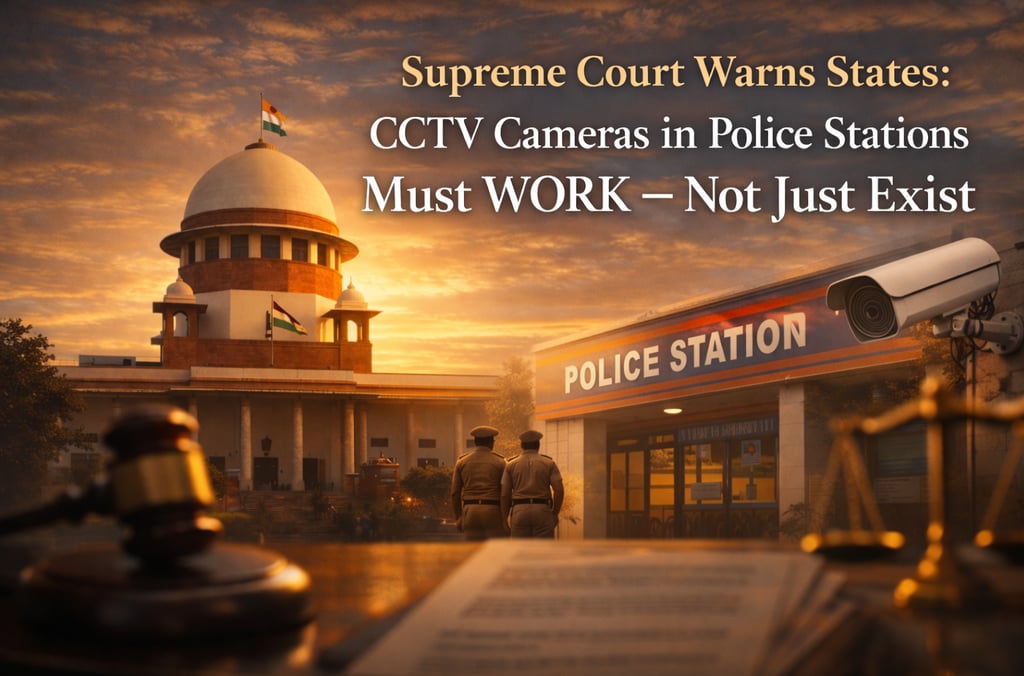
Police Station CCTV Compliance: Supreme Court Issues Warning
Supreme Court stresses functional CCTV systems in police stations, reinforcing custodial transparency and compliance with Paramvir Singh Saini guidelines.
Adv. Nadeem Saifi | Altius Astra Attorneys | Delhi
2/5/20262 min read
Beyond Installation: Why the Supreme Court Wants Functional CCTV Accountability in Police Stations
CONSTITUTIONAL IMPERATIVE: THE FOUNDATION OF TECHNOLOGICAL ACCOUNTABILITY
The Supreme Court's insistence on functional CCTV systems in police stations is deeply rooted in India's constitutional jurisprudence, specifically the protection of life, liberty, and dignity under Articles 21 and 22. This scrutiny transcends mere administrative upgrade; it is a constitutional objective to prevent custodial abuse and unlawful detention. The Court, building upon its landmark directive in Paramvir Singh Saini v. Baljit Singh (2020), has clarified that technological compliance is not a box-ticking exercise. In its recent suo motu proceedings (2025), the bench reinforced a critical principle: surveillance infrastructure must be effectively operational, as mere installation fails to fulfil the state's constitutional obligations.
FROM PAPER COMPLIANCE TO FUNCTIONAL REALITY: THE COURT'S SCRUTINY
The Court's intervention was triggered by reports of custodial deaths and systemic failures in maintaining CCTV infrastructure. Moving beyond installation statistics, the hearings meticulously examined real-world functionality, monitoring mechanisms, and data preservation. The judiciary expressed clear dissatisfaction with perfunctory compliance reports from various states and agencies, emphasising that reporting without substantive implementation undermines judicial mandates. The proceedings also highlighted best practices from proactive states, showcasing models like centralized monitoring dashboards and integrated oversight frameworks as benchmarks for genuine compliance.
OPERATIONAL HUDDLES AND THE DEMAND FOR SUSTAINABLE SYSTEMS
A core revelation of the hearings was the focus on persistent operational challenges that render cameras useless. The Court highlighted critical gaps in network connectivity, camera maintenance, data storage capacity, and monitoring oversight. While noting positive steps, such as Rajasthan's budgetary allocation for expanded coverage, the bench remained steadfastly focused on long-term functional sustainability. The underlying message is that without addressing these technical and administrative hurdles, CCTV systems lose their very purpose—to ensure transparency and deter misconduct within police precincts.
LEGAL REPERCUSSIONS: SHIFTING EVIDENTIARY LANDSCAPES AND INSTITUTIONAL DUTY
This judicial stance carries profound strategic implications. For criminal lawyers, it strengthens evidentiary expectations, making functional CCTV footage potential primary evidence in cases of custodial violence. For investigating agencies, it mandates a shift toward technology-backed transparency, where digital records may become crucial in disciplinary proceedings. The ruling expands institutional responsibility beyond police departments to state governments and central agencies, imposing a duty to establish robust maintenance ecosystems, including annual audits and tamper-proof storage. Defence counsel may now strategically seek audit logs and maintenance records alongside actual footage.
A PARADIGM SHIFT IN GOVERNANCE: PERFORMANCE OVER PROCEDURE
Ultimately, the Supreme Court is engineering a paradigm shift from policy-level to performance-based compliance. For citizens, this strengthens institutional accountability by linking technological adoption directly to measurable improvements in rights protection. The Court positions digital infrastructure not as an optional administrative tool but as an integral component of constitutional due process. This evolution in compliance jurisprudence underscores that institutional credibility hinges on demonstrable operational integrity, ensuring that technology actively strengthens governance and custodial safety rather than serving as a decorative facade.
Legal Analysis by Advocate Nadeem Saifi | Altius Astra Attorneys | Delhi
A full-service law firm specializing in litigation, dispute resolution, and strategic legal advisory before the District Courts of Delhi NCR, Delhi High Court, and the Supreme Court of India.
Altius Astra Attorneys
A premier law firm based in Delhi, India, offering legal representation across various practice areas for citizens rights and interests.
© 2025. Altius Astra Attorneys. All rights reserved.
Contact Us
📞 9899290789, 9818786756
📧 contact@altiusastra.com
3C-ED Block, Madhuban Chowk, Pitampura, Delhi-110034
DISCLAIMER