
When Celebrity Status Meets Courtroom Discipline: Delhi High Court Orders Actor Rajpal Yadav to Surrender in Cheque Dishonour Dispute
Delhi High Court orders Bollywood actor Rajpal Yadav to surrender in cheque bounce cases, stressing accountability for breached undertakings under Section 138 of the Negotiable Instruments Act.
Nadeem Saifi | Advocate | Altius Astra Attorneys
2/4/20263 min read
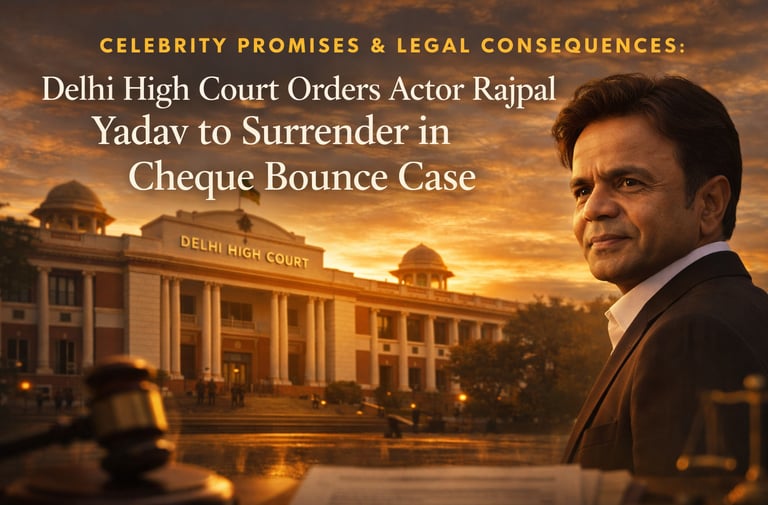
Cheque dishonour litigation under Section 138 of the Negotiable Instruments Act, 1881 occupies a unique position in Indian criminal jurisprudence, where courts, while criminalizing financial default, consistently encourage settlements to ease the burden on the justice system and restore the complainant’s financial position; however, this settlement-driven approach rests on the fragile foundation of the credibility of court undertakings, a dilemma underscored in SH. Rajpal Naurang Yadav & Anr v. M/s Murli Projects Pvt. Ltd & Anr | Delhi High Court | 2026, which sends a critical message that court indulgence is not unconditional and that such undertakings are binding commitments with serious legal consequences, compelling courts to weigh compassion against the integrity of the judicial process when assurances are dishonoured.
Delhi High Court's Stern Stance on Breached Settlement Undertakings in Cheque Dishonour Case By Bollywood Actor Rajpal Yadav
This legal development arose from convictions under Section 138 of the Negotiable Instruments Act for cheque dishonour, where the Delhi High Court, initially extending leniency by referring the matter to mediation, granted the accused repeated opportunities and extensions to fulfil a substantial crore-valued settlement through structured payments and demand drafts; however, after consistent non-compliance and procedural explanations like typographical errors, the Delhi High Court concluded that such breached undertakings undermined the judicial process, ultimately directing the release of deposited funds to the complainant company and ordering the accused Actor Rajpal Yadav to surrender and serve the original sentence of simple imprisonment imposed by the trial court.
Judicial Reasoning on the Sanctity of Court Undertakings in Section 138 Cases
The judicial reasoning affirmed the fundamental principle that an undertaking to the court is a solemn assurance to the institution of justice itself, where repeated breaches erode the legal process's credibility and constitute a direct challenge to the court's authority, especially when relief like suspension of sentence is granted based on such representation. This reflects the essential balancing act in Section 138 jurisprudence, which, while quasi-criminal and aimed at securing payment, retains imprisonment as the statutory mechanism for financial accountability, clarifying that settlement opportunities cannot shield against a lawful sentence when assurances fail. Ultimately, the Court reaffirmed the limited scope of judicial indulgence, stating that discretion is contingent on bona fide conduct, and a pattern of delay and non-compliance collapses any justification for continued leniency.
Strategic Legal Implications and Advisory for Section 138 Litigation
This ruling provides crucial strategic legal implications, serving as a cautionary guide for lawyers advising clients that seeking suspension of sentence or settlement-based relief must be backed by a realistic payment plan, and delivers a direct message to litigants that a settlement under judicial supervision creates enforceable expectations where failure can accelerate the execution of criminal sentences rather than avoid it. For courts, it reinforces a framework of accountability, preserving the credibility of mediation by preventing its misuse to indefinitely defer consequences. Broadly, it strengthens the position of complainants in cheque dishonour cases, signaling the judiciary will protect their interests by ensuring procedural leniency is not converted into a means of evasion.
Public Impact: Reinforcing Trust in Legal Accountability for Cheque Dishonour
From a public impact perspective, this decision reinforces confidence in the legal system for small businesses and individuals relying on cheques as instruments of trust, demonstrating active enforcement of accountability when court-directed settlements are breached. Furthermore, it highlights a crucial civic lesson that engaging with the judiciary is not an informal negotiation, as assurances carry significant legal and moral weight, with non-compliance risking serious personal consequences like loss of liberty. Ultimately, in an era where financial disputes frequently enter criminal courts, the judgment clarifies that while reconciliation and payment are encouraged, they must be pursued with genuine sincerity and diligence.
Professional Legal Insight: Settlement as Privilege, Not Right, in Section 138 Defence Strategy
From a professional legal insight, this decision establishes a clear boundary between judicial compassion and judicial authority, affirming that settlement in Section 138 cases is a privilege extended to facilitate justice, not a procedural right to dilute it. For defence strategy, it underscores the critical need for transparency and flawless execution of a documented payment mechanism, as any lapse can be construed as a lack of bona fides against a history of non-compliance. Conversely, for complainants' counsel, the ruling provides a strong basis to resist endless adjournments and press for enforcement when undertakings are breached, confirming courts will shift from conciliatory to coercive measures as facts demand. Ultimately, this judgment reinforces a growing jurisprudence that preserves the sanctity of court proceedings in financial litigation, reminding all stakeholders that the credibility of justice hinges on faithful compliance with commitments made before the law.
Legal Analysis by Advocate Nadeem Saifi | Altius Astra Attorneys | Delhi
A full-service law firm specializing in litigation, dispute resolution, and strategic legal advisory before the District Courts of Delhi NCR, Delhi High Court, and the Supreme Court of India.
Altius Astra Attorneys
A premier law firm based in Delhi, India, offering legal representation across various practice areas for citizens rights and interests.
© 2025. Altius Astra Attorneys. All rights reserved.
Contact Us
📞 9899290789, 9818786756
📧 contact@altiusastra.com
3C-ED Block, Madhuban Chowk, Pitampura, Delhi-110034
DISCLAIMER